
Softskills
Gaming and Teamwork: Five Communication Habits to Practise

In this guide
- Begin with a situation your teenager recognises
- Say what happened before assigning blame
- Give one useful update at a time
- Check that everyone understands the plan
- Invite another view
- Review one moment and choose a next step
- A small activity for your next conversation
- Good teamwork includes knowing when to stop
- Practising communication through Squid
What does good teamwork sound like in a game? It might be a short update, a check that everyone is ready or a question that gives a quieter teammate room to speak. If your teenager already plays team games, choose one of those moments to talk about together.
The goal is deliberate practice. Playing more matches does not, on its own, show that someone is becoming a better communicator.
You do not need to coach the game. Ask your teenager to explain a team moment, then explore how the conversation could work better.
Begin with a situation your teenager recognises
Try this question at a calm time: “When your team gets confused, what do people usually say?”
They might describe several players talking at once, someone giving instructions too late, or a teammate blaming someone after a mistake. Ask them to choose one situation they would like to handle differently.
Use an existing, age-appropriate activity with people your family knows and trusts. Agree on communication settings and supervision first. There is no need to join a public chat or contact strangers to try these ideas.
Australia’s eSafety Commissioner advises families to agree on who a child can communicate with, which features they can use and how interactions will be supervised. Its guidance also explains risks associated with private messages and requests to move conversations elsewhere. Read eSafety’s guidance on playing games with others.
The five habits below are practice suggestions. The conversations are fictional examples.
1. Say what happened before assigning blame
Compare these two responses:
“You never listen.”
“I started before you were ready. Next time, can we check first?”
The second response identifies an action and suggests something to change. It also leaves room for the other person to explain what they saw.
Ask your teenager to turn one blaming statement into an observation and a request. Keep it specific: what happened, and what would help next time?
Try it elsewhere: In a school project, “The slides were not ready when we met” gives the group a clearer issue to discuss than “You do nothing.” Follow it with a practical request about who will complete which section and when.
2. Give one useful update at a time
In team games, players sometimes use the word “callout” for a short update about something relevant to teammates.
Compare:
“Over there! Do something! Why isn’t anyone helping?”
“I need help on the left. Can someone join me?”
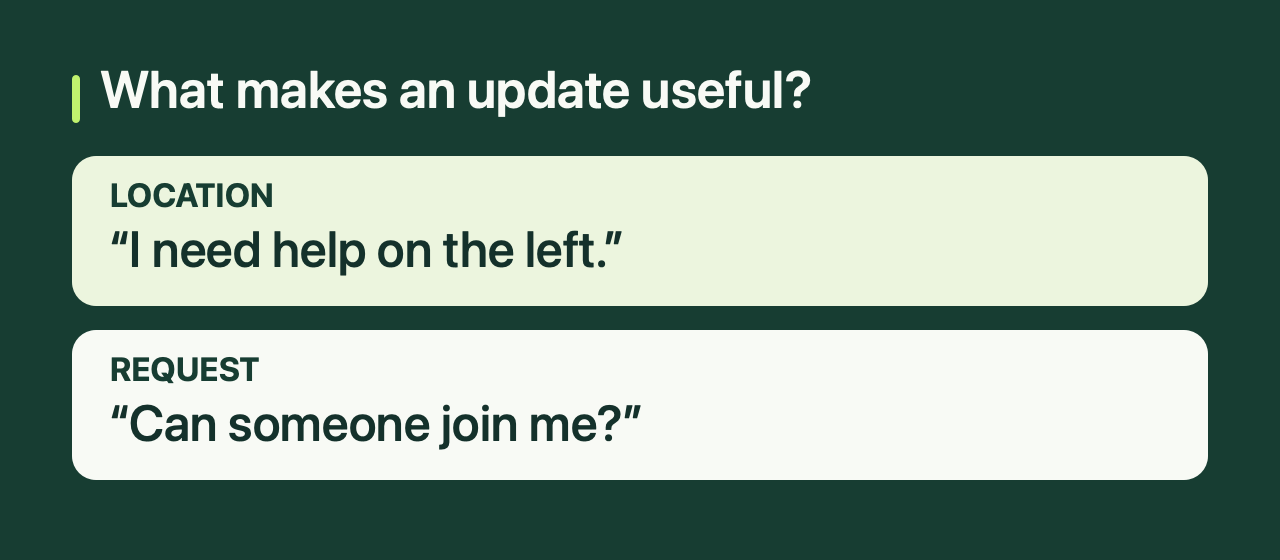
The right wording will depend on the game and the group’s shared vocabulary.
Ask: “What information would your teammate need to choose their next action?” Practise giving that information without adding an argument or repeating it over everyone else.
Try it elsewhere: Before a family outing, “I have packed the water; we still need the tickets” gives a useful update about a shared task.
3. Check that everyone understands the plan
Hearing a suggestion is different from agreeing on who will do what.
Compare:
“Everyone knows the plan. Go.”
“I’ll wait here while you check the route. Are we both ready?”
Ask your teenager to describe the plan in one sentence and invite a teammate to add anything missing. The purpose is to make responsibilities clear, while leaving space for questions or disagreement.
Try it elsewhere: At the end of a group-project meeting, each person can say what they are doing and when they will bring it back. That is a new opportunity to practise the same behaviour in a different setting.

4. Invite another view
Taking responsibility for a team does not require making every decision yourself.
Compare:
“Just do what I say.”
“I think we should wait. What can you see from your position?”
The second response explains a view and asks for information. It gives a teammate a chance to contribute something the speaker may have missed.
Try this when there is time to discuss a plan, such as before an activity or during a review. A fast-moving moment may need a brief, already-agreed instruction instead.
Try it elsewhere: In a friendship disagreement, “What did you think happened?” opens a conversation. Listening does not require agreeing, but it does require giving the answer room.
5. Review one moment and choose a next step
After an agreed stopping point, ask permission to discuss one moment. You could use a moment your teenager remembers; you do not need to record the session.
Ask three questions:
- What were you trying to do?
- What did the other person need from you?
- What would you say or do differently next time?
Keep the review focused. “We lost because everyone was bad” gives little direction. “Next time I will check whether the team is ready before starting” identifies something to practise.
If you use a recording, first check consent, privacy and the relevant platform rules. Keep other people’s voices, usernames and personal information out of anything you share.
A small activity for your next conversation
Choose one habit together. Ask your teenager to give an example of how it might sound, then try it during an activity already in their routine.
Afterwards, discuss one moment when it helped or felt difficult. A useful practice note could be:
“I asked whether we were ready, but I acted before the reply. Next time, I’ll wait for an answer.”
That is a specific reflection, even if the team lost. Avoid treating a win as proof of good communication or a loss as proof of failure.
If the behaviour would be useful at school or home, agree on one separate opportunity to practise it there. Ask how that attempt went. A connection between the situations is something to explore and rehearse, not an automatic benefit of gaming.
Good teamwork includes knowing when to stop
Respectful communication does not mean staying in a harmful conversation. If someone becomes abusive or makes your teenager uncomfortable, help them step away and use the game’s mute, block or report tools as appropriate. They can also speak to you or another trusted adult. eSafety includes these actions in its advice about responding to harmful interactions. See its guidance on getting support while playing with others.
The practice is optional. If your teenager does not want a discussion after playing, agree on another time rather than turning every game into a lesson.
Practising communication through Squid
Squid’s Leadership programme addresses soft skills through a dedicated curriculum, classroom-style teaching, textbooks and notes. Competitive begins with the learner’s game, experience and performance goals, with relevant teamwork, communication, leadership, decision-making and composure skills taught through coaching and gameplay.
For an overview, read what teenagers can learn through esports education. If your teenager wants to try structured esports learning, you can book a free trial and discuss their goals with the team.
Explore another topic